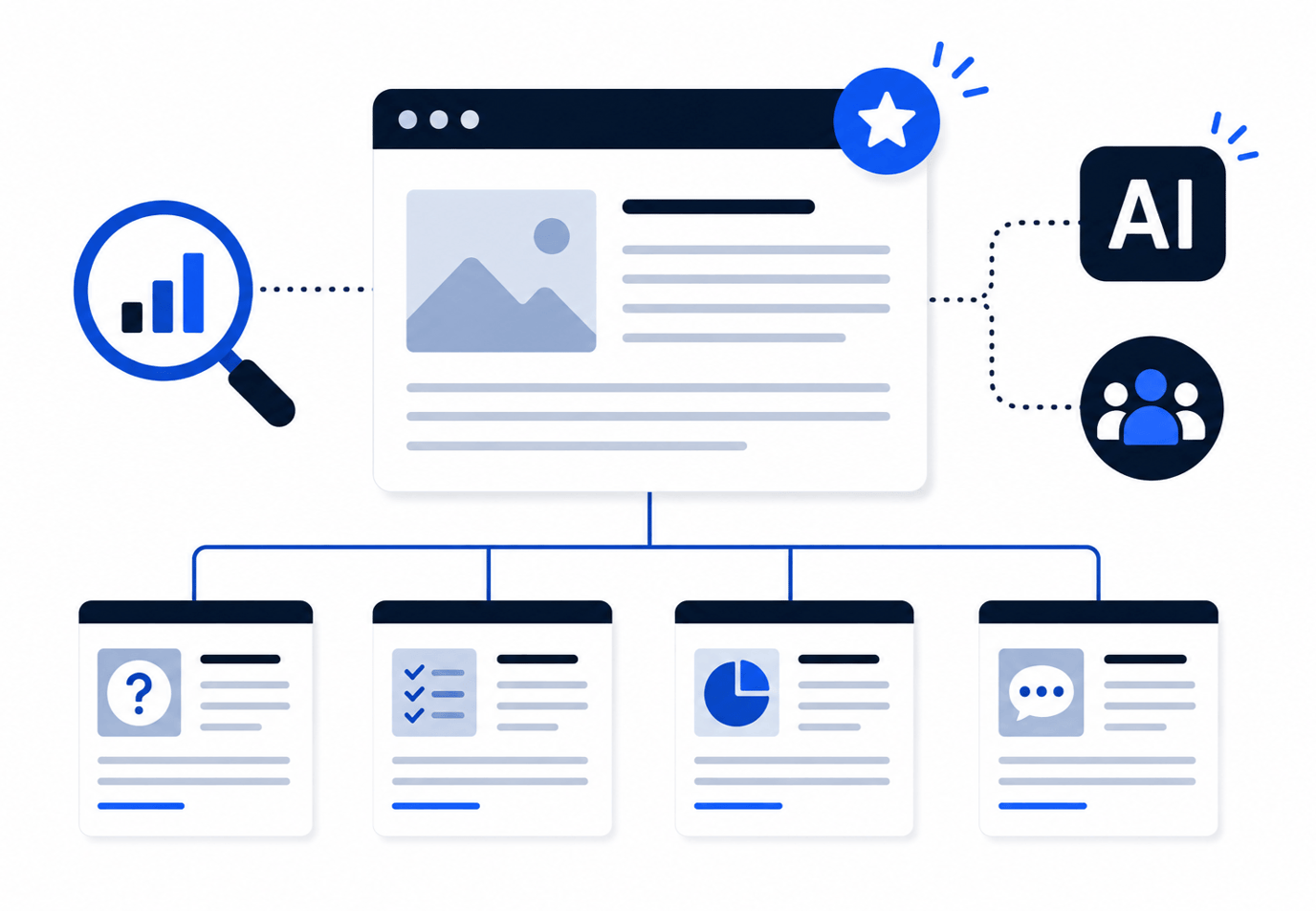
A technical SEO audit uncovers the issues preventing search engines from properly crawling, indexing and ranking your website. Discover what an audit actually looks for, why it matters, and how fixing technical problems can help you compete more effectively in Google search.

There’s a lot of noise right now about AI search. ChatGPT, Claude, Gemini – the conversation in marketing circles has shifted to how you get cited by AI tools, and how you need to be worried about how you’re showing up there. It’s a legitimate conversation, but it can also be a distraction. That’s because it implies Google’s dominance is fading, but this isn’t really the case.
Here’s what the data actually shows: Google still holds around 90% of global search market share. For every person using an AI search tool, there are roughly three and a half people using Google. AI search is growing fast, but most of your potential customers are still opening a browser and typing into Google. That hasn’t changed enough, yet, to stop treating Google visibility as a priority.
Which makes it all the more frustrating when a business discovers, often by accident, that Google can barely find them at all.
The moment you realise your competitors are showing up and you’re not
It usually comes up in a conversation rather than a report. Someone searches for a service they know their own business offers, and a competitor appears. Then another. Their own website is nowhere. Not on the first page, not on the second. And this is for terms that describe exactly what they do.
The instinct is often to blame the content, or the age of the website, or the budget spent on Google Ads. But the real cause is usually more fundamental, and more fixable. It’s technical.
What “technical SEO” actually means
Technical SEO is about whether search engines can find, read, and understand your website – before any question of content or keywords comes into play. It’s the infrastructure layer. When it’s broken, everything else is pretty irrelevant: you can have the best content in your sector and still be invisible if Google can’t properly access or interpret your site.
A technical SEO audit is the process of going through that infrastructure systematically, finding what’s working and what isn’t.
Here’s what we’re actually looking at when we run one.
Indexation. The first question is simple but often surprising: how much of the site can Google actually see? We check which pages are indexed, which are blocked, and whether there are pages that Google is trying to crawl but encountering errors on. A recent audit we carried out found that less than half of a website’s pages were actually indexed. The business had invested time creating content that Google had never seen.
Crawlability. Even if pages are indexed, we need to check that Google can reach them efficiently. That means reviewing the robots.txt file (which controls what crawlers can and can’t access), the XML sitemap (which helps Google navigate the site), and any crawl errors that might be blocking progress. Redirect chains – where one URL redirects to another, which redirects to another – are a common culprit. They slow crawlers down and dilute the signals you’re trying to send.
Page speed and Core Web Vitals. Google uses real-world performance data as a ranking signal. Core Web Vitals measure things like how quickly content loads, how stable the page is as it loads, and how quickly it becomes interactive. A site that’s slow to load or shifts around as elements come in will be penalised for it. We look at performance across both desktop and mobile – which matters more than many people expect, given that mobile accounts for the majority of searches.
Site structure and internal linking. Search engines need to understand what a site is about and which pages are most important. A flat, well-connected site structure, where key pages are no more than a few clicks from the homepage, and where internal links reinforce the relationships between related content, makes a significant difference. Sites that have grown organically over years, with pages added ad hoc and navigation that’s never been reviewed, often have structure that actively works against them.
Duplicate content and canonical issues. Search engines don’t like uncertainty about which version of a page is the “real” one. If the same content can be accessed via multiple URLs, with or without a trailing slash, via HTTP and HTTPS, through category pages that generate near-duplicate listing pages, Google has to make judgments about which version to rank. Those judgements aren’t always in your favour. Canonical tags tell Google which version to use; they’re often missing or wrong.
Metadata. Title tags and meta descriptions aren’t just for humans – they’re key signals to search engines about what each page covers. Duplicate titles across a site, missing meta descriptions, titles that are too long to display properly in search results: these are all issues that crop up repeatedly and are straightforward to fix once identified. They’re so simple, but often overlooked.
Structured data. Schema markup is code that tells search engines, in an unambiguous way, what’s on a page – whether that’s a business, a product, a review, an event, or something else. Done well, it can improve how your listings appear in search results. Done badly or inconsistently, it creates confusion. Many sites have no schema at all.
Why a checklist isn’t enough
It’s possible to read a list like this and think “we can work through this ourselves.” Some of it, you can. But an audit isn’t really a checklist. It’s a diagnostic process. The same symptom – low rankings, poor crawl coverage, thin indexed content – can have a dozen different causes, and treating the wrong one wastes time.
It also requires tools that aggregate data from multiple sources: Google Search Console, crawl analysis platforms, performance monitoring, log file analysis. The picture only emerges when you pull those sources together and look at the site as a whole, not page by page.
And perhaps most importantly: an audit needs to end with a prioritised set of actions. Not a 40-page document that lists every issue, but a clear view of what’s causing the most damage and what to fix first. High impact, low effort changes tend to be clustered in a small part of the issue set. The value of an audit is knowing which part.
The thing that surprises businesses most
When we run audits, there’s usually one finding that surprises clients more than the others. It’s rarely the slowest page or the missing meta description. It’s the indexation gap – the discovery that a significant portion of the site, sometimes the majority of it, isn’t appearing in Google’s index at all.
Content that’s been written, reviewed, published and linked to, but that Google has never picked up. The reasons vary: blocked by robots.txt, flagged as duplicate, excluded by noindex tags added during development and never removed, or simply not being crawled because the site structure doesn’t lead Google there.
It tends to change how people think about SEO. The problem isn’t (or isn’t only) “we need more content.” It’s “we need to make sure the content we already have is actually being seen.”
Where to start
If you’re reading this because you’ve searched for your own business or services and come up short, the next step isn’t to add more pages or start a blog. It’s to understand what’s already stopping Google from finding what you’ve got.
We offer free SEO audits for businesses that want a clear picture of where they stand – what Google can and can’t see, what’s holding back visibility, and what the realistic options are. It’s the fastest way to understand whether you have a technical problem, a content problem, or both.