When an AI agent visits your website, it doesn't see what your visitors see. It reads a structured, semantic version of your page - therefore a more accessible website will help with your AI search results.
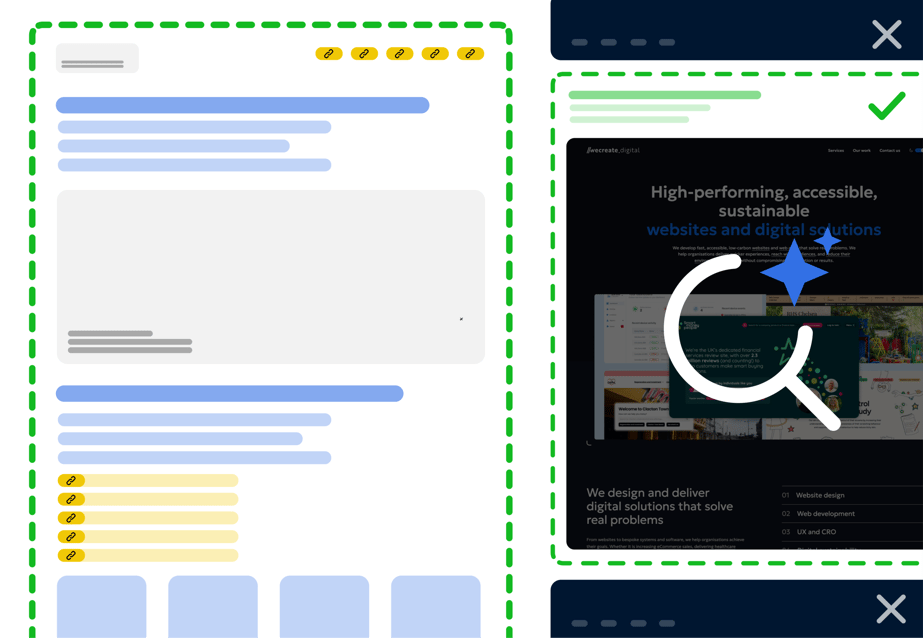
When an AI agent visits your website, it doesn’t admire your hero image or register your brand colours. It reads your accessibility tree.
The accessibility tree is a structured, semantic layer your browser builds from the page. It contains roles, names, and states: “this is a button, it says ‘Get a quote’, it’s clickable.” It won’t explain the visuals, or styling – just the meaning.
This isn’t new. Anyone who’s worked in accessibility has understood for years that a well-structured page i.e. correct heading hierarchy, properly labelled buttons, semantic HTML, meaningful alt text, makes the website work for people using screen readers and other assistive technology. AI agents have apparently now caught up to the same reasoning.
The argument for getting it right hasn’t changed. It’s just got more people paying attention because AI is now involved.
Why it matters for SEO and GEO
Traditional search engines have always rewarded well-structured pages. Clean heading hierarchies, descriptive anchor text, and semantic HTML have been technical SEO fundamentals for years. Those patterns are what make a page easy for a crawler, and now for an AI model.
Generative engine optimisation (GEO) – being cited, quoted, or recommended by AI tools like ChatGPT, Copilot, or Perplexity – works on the same basis. If an AI agent can’t reliably read your page structure, understand what your buttons do, or extract your key content, your chances of appearing in an AI-generated response drop.
OpenAI has confirmed that ChatGPT interprets page structure through ARIA roles and labels. Microsoft’s Playwright framework, which is widely used for agent-based browsing, is built around accessibility snapshots rather than screenshots for exactly this reason. The structure you build for screen reader users is therefore the structure AI reads too. So if you have an accessible website, you’re scoring points for AI visibility.
What “doing it properly” actually looks like
Accessibility exists to make the web usable for people with disabilities. That’s the purpose, and everything in the Web Content Accessibility Guidelines (WCAG) was written with that goal in mind, whether someone’s using a screen reader, navigating by keyboard, or simply needs clearer contrast and larger text. The SEO and GEO benefits are a side effect of doing it well, but it will be interesting to see if more websites become accessible now because of these.
In practice, the things that make a site accessible are also the things that make it legible to search and AI:
- Buttons that are real buttons (not divs styled to look like buttons) with text that describe what they do rather than just “click here”
- Form inputs with proper labels, not just text positioned nearby that looks associated but isn’t
- Heading levels that follow a logical sequence, such as H1, H2, H3, not just to look good visually
- Alt text on meaningful images that describes what they show, not just the filename or “image”
- Semantic landmarks such as navigation, main content, footer etc so the page has structure, not just layout
Most of this is just using the right HTML element for the task; it’s not technically complex. It tends not to get done because it requires deliberate decisions at the design and development stage, not as an afterthought. And when accessibility is presented as the reason, it’s often dismissed because it doesn’t affect the majority of users.
The common thread
Screen readers, search engine crawlers and AI agents are all asking the same question: what does this page contain, what can you do on it, and what does it mean?
Sites that answer those questions clearly perform better across all three. Not because they’ve optimised separately for each, but because they’ve built something that’s genuinely easy to understand.
That’s what good accessibility has always done, and we’re hopeful that now there is a clear benefit when it comes to AI results, more organisations will pay attention, therefore providing a better experience for disabled users.
https://searchengineland.com/accessibility-tree-seo-use-cases-484338
Search Engine Land