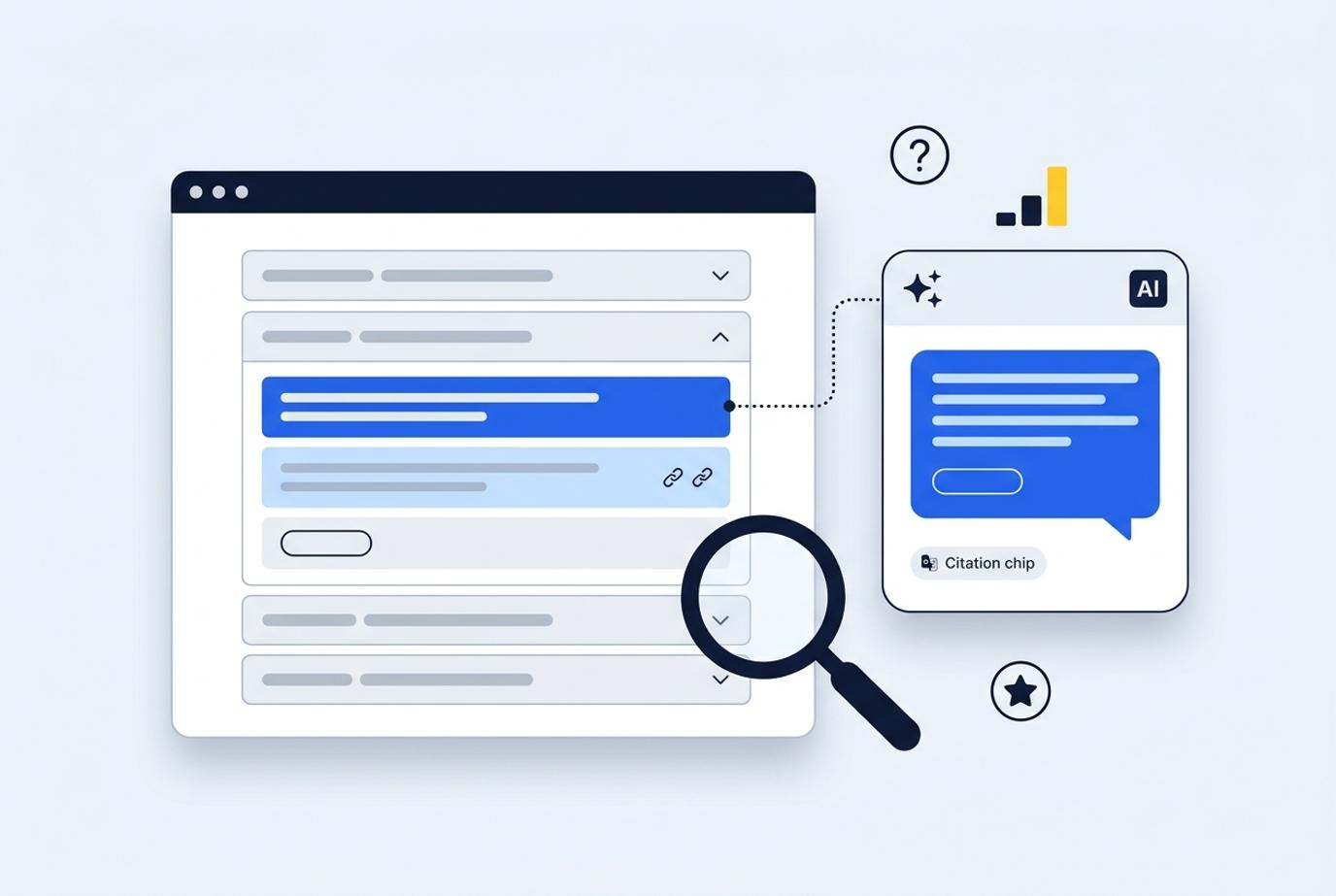
This article explains why generic FAQs rarely get cited by AI Overviews and LLMs, and sets out a practical framework for writing answers that do.
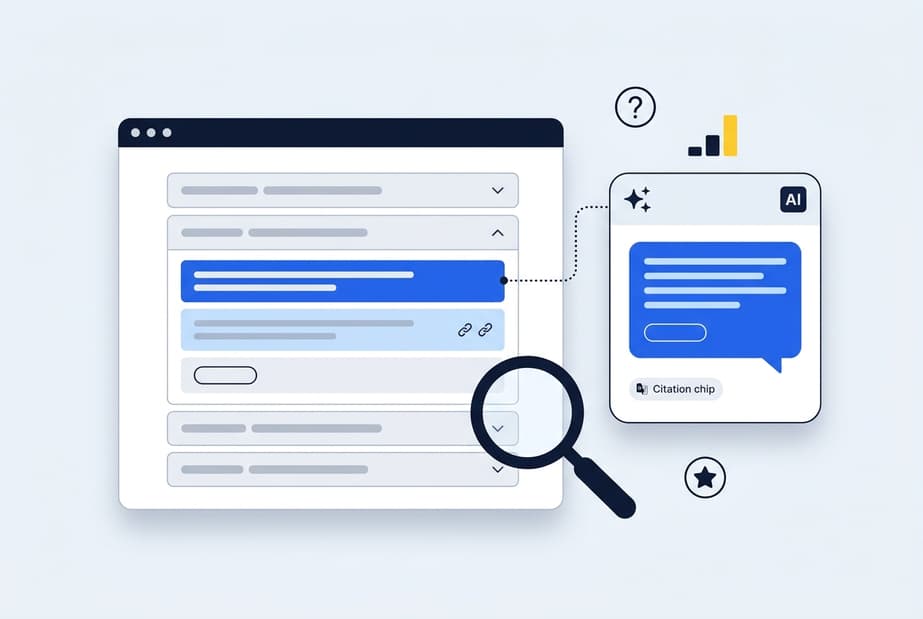
Google’s AI Overviews and LLM answer engines (such as ChatGPT, Claude and Perplexity) all work in a similar way. They take a question and the context, retrieve passages from across the web and assemble an answer, often citing the sources they drew from.
This is well known and many companies are now focused on ensuring they have answers to these questions and become sources for these tools. However, what many companies don’t realise is that asking an LLM to generate an FAQ for you will often lead to a handful of generic questions with one-line answers.
While they do tick the box and may in some cases be successful, more often these will not get cited as sources by Google or LLMs. Why?
Well, there is a framework in place to decide if a source is credible and there are specific approaches that mean a brand can be recognised alongside the answer.
The three-part answer FAQ structure
We structure every FAQ answer in three layers. Each one serves a different purpose, for both people and machines.
- The extractable answer
Open with one or two sentences that fully answer the question. Aim for roughly 40 to 60 words, name the subject explicitly and avoid hedging openers such as “it depends”. This is the passage most likely to be lifted into an AI response or featured snippet.
- The evidence layer
The second paragraph adds depth: the reasoning, the conditions, the specifics. This is where you link to relevant pages on your own website and to authoritative external sources such as industry bodies, official guidance or recognised standards. Answer engines favour content that is well connected and corroborated, and this layer signals that your answer is grounded rather than generic.
- The action and attribution layer
The final paragraph gives the reader a next step, such as a tool, a guide or a way to get in touch and names your brand naturally. When AI tools summarise or cite your content, a clear brand mention increases the chance your business is credited as the source of the expertise.
Basic versus advanced: an example
Here’s the same question answered two ways.
The basic version
Why is SEO good for business?
SEO helps your website rank higher on Google, which brings in more traffic.
It’s accurate, but it adds nothing an AI tool couldn’t generate itself. There’s no reason to cite it.
The advanced version
Why is SEO good for business?
Strong SEO practices provide better information to Google and to users of the search engine, increasing the likelihood that they will visit the website and contact the business in question (or take the desired action).
SEO covers several areas, including technical SEO, which considers page load speed and the benchmarks set out in Google’s Core Web Vitals, and content (or on-page) SEO, which focuses on the content itself. Other considerations include backlinks and domain authority, which search engines use to decide whether a source should be trusted for a specific query.
You can use the free Google Search Console links report to view the backlinks pointing to your website. Search Console needs to be set up first, which is a quick process requiring verification of your website. Need technical SEO support? Talk to We Create Digital about setting this up so you have better visibility of your Google search traffic.
The first paragraph can stand alone in an AI answer. The second adds depth and corroboration. The third offers a practical tool, a next step and a clear brand attribution.
Be consistent everywhere
Answer engines compare sources. If your website says one thing in an FAQ, another in a blog post and a third on a product page, you undermine your own credibility.
Audit key facts across your site, including specifications, timescales, policies and prices, and make sure every mention agrees. Inconsistencies are surprisingly common, especially on sites with years of accumulated content, and they are an easy win for anyone willing to fix them.
Put FAQs where the question arises
A single FAQ page covering everything is the basic approach. The advanced approach places focused FAQs on the page where each question naturally belongs: product questions on product pages, service questions on service pages and topic questions within the relevant guide.
This keeps each answer closely tied to its subject, which helps search engines and AI tools understand context. Scale the number of questions to the page, and avoid repeating the same FAQ across multiple pages, as this dilutes its value and blurs which page should be the source.
Get the structure right
How your FAQs are marked up affects how easily they can be read, both by people using assistive technology and by machines.
Give the section its own heading. Use a clear title such as “[Topic] FAQs” as an H2, so it sits as a distinct section of the page.
Make each question a heading. Mark questions up as headings rather than bold text. This helps screen reader users navigate and helps machines pair each question with its answer.
Keep the hierarchy logical. Best practice is for headings to step down one level at a time, so questions beneath an H2 would ideally be H3s. If your theme styles another level more suitably, that can work, but apply the same pattern consistently across the site.
Phrase questions the way people ask them. Use full, natural questions (“How long does patio sealer last?”) rather than labels (“Sealer lifespan”). This mirrors how people type and speak to AI tools.
Keep answers in plain, visible text. Answers should be in the page’s HTML when it loads, not pulled in by a script only when someone clicks. Accordions are fine as long as the text is present in the page source.
Note: Keep answers current!
An outdated answer is worse than no answer, because it can be repeated confidently by an AI tool long after it stopped being true.
Review FAQs whenever services, products or policies change, check links periodically and update the specifics as your expertise grows.
Want your content to show up in AI answers?
At We Create Digital, we help businesses structure their content for AI Overviews and answer engines, from FAQ strategy and on-page content to schema and AI visibility reviews. Get in touch to find out how your website currently appears in AI-generated answers.